Oculum VR did not begin as a polished corporate rollout. It began as a student-led idea in Western Australia, with founder Alfie Curran-Ragan exploring whether immersive technology could be used for something more practical than spectacle.
That original question was simple: if virtual reality can place somebody inside a controlled environment, could it be used to help people learn, practise and eventually demonstrate real skills more effectively?
From there, the idea gradually shifted from a concept into a real project. Rather than chasing consumer hype, Oculum VR started leaning toward the less glamorous side of XR—training, assessment and practical workplace use cases.
From idea to early-stage venture
Alfie says the project was shaped as much by conversation as by technology. Instead of trying to build a finished product in isolation, he spent time talking with people in training and industry to understand where immersive tools might actually fit.
“I was never interested in making something just because VR looks futuristic. I wanted to understand whether it could genuinely help with a real-world training problem.”
That approach gave Oculum VR a more grounded direction. Rather than treating VR as a replacement for every part of training, the company’s concept has been built around situations where simulated environments may add value—particularly where repetition, risk or consistency are difficult to manage in the real world.
Putting the project in front of people
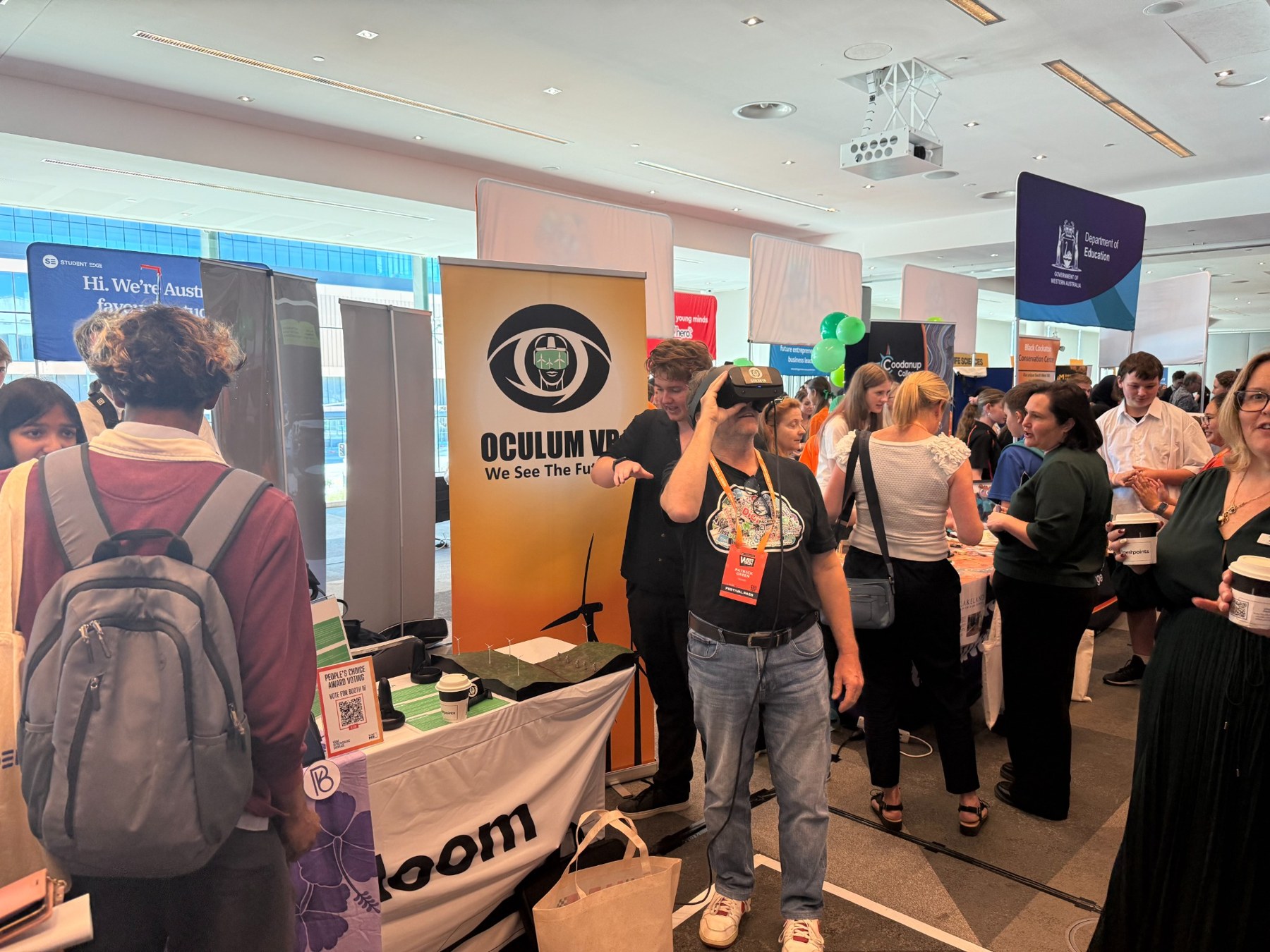
As the idea developed, Oculum VR also began appearing more visibly in the WA startup and innovation space. Events, demonstrations and founder programs helped move the project beyond a private idea and into public conversation.
Alfie says opportunities to be involved in the local startup community—including experiences around West Tech Fest—helped sharpen the way he thought about both the problem and the audience.
“Once you start showing people what you’re building, you learn very quickly what makes sense to them, what confuses them and what they actually care about. That was really valuable.”
That process matters for early XR ventures. A headset demo can attract curiosity, but turning that curiosity into a useful product requires a clearer understanding of who the user is, what problem is being solved and why immersive technology is the right tool.
Why the focus stayed on training
For Oculum VR, the answer kept pointing back to practical learning. Training offers an environment where immersion can serve a purpose: showing context, increasing repetition and allowing scenarios to be staged in a more controlled way.
The result is still an early-stage venture rather than a finished empire—and that is precisely what gives the story credibility. Oculum VR is better understood as a project that has become real through steady development, public exposure and problem-led thinking.
“For me, the goal is not to sell VR for the sake of it. The goal is to build something useful, and if immersive technology is the right way to do that, then that’s where the project goes.”
That is a quieter story than the biggest promises in tech, but it may be the more durable one. In the Australian XR scene, Oculum VR stands out not because it claims to have solved everything already, but because it is clearly trying to turn a genuine idea into a practical venture.